
Our AI Implementation Process
From Strategy to System: The Jurvantis.ai Implementation Approach
AI implementation in a law firm is not a single installation event. It is a structured transformation process. When done correctly, it reshapes how your firm operates, thinks, communicates, and delivers legal services. When rushed or poorly scoped, it creates confusion, wasted expense, and abandoned systems.
This page explains exactly how Jurvantis approaches AI implementation and why the process differs depending on the type of AI deployment your firm chooses.
Some firms want rapid transformation. Others prefer a measured evolution. Both approaches work. The key is clarity, structure, and purposeful sequencing.
AI implementation is not about turning everything on at once. It is about deploying the right systems in the right order, at the right pace.
Understanding the Five Types of AI Deployment in Law Firms
Before any workflows are designed or systems are built, we align on a critical question: what type of AI transformation are we implementing?
AI impacts law firms across five distinct categories. Each requires a different strategy, build approach, and implementation structure.
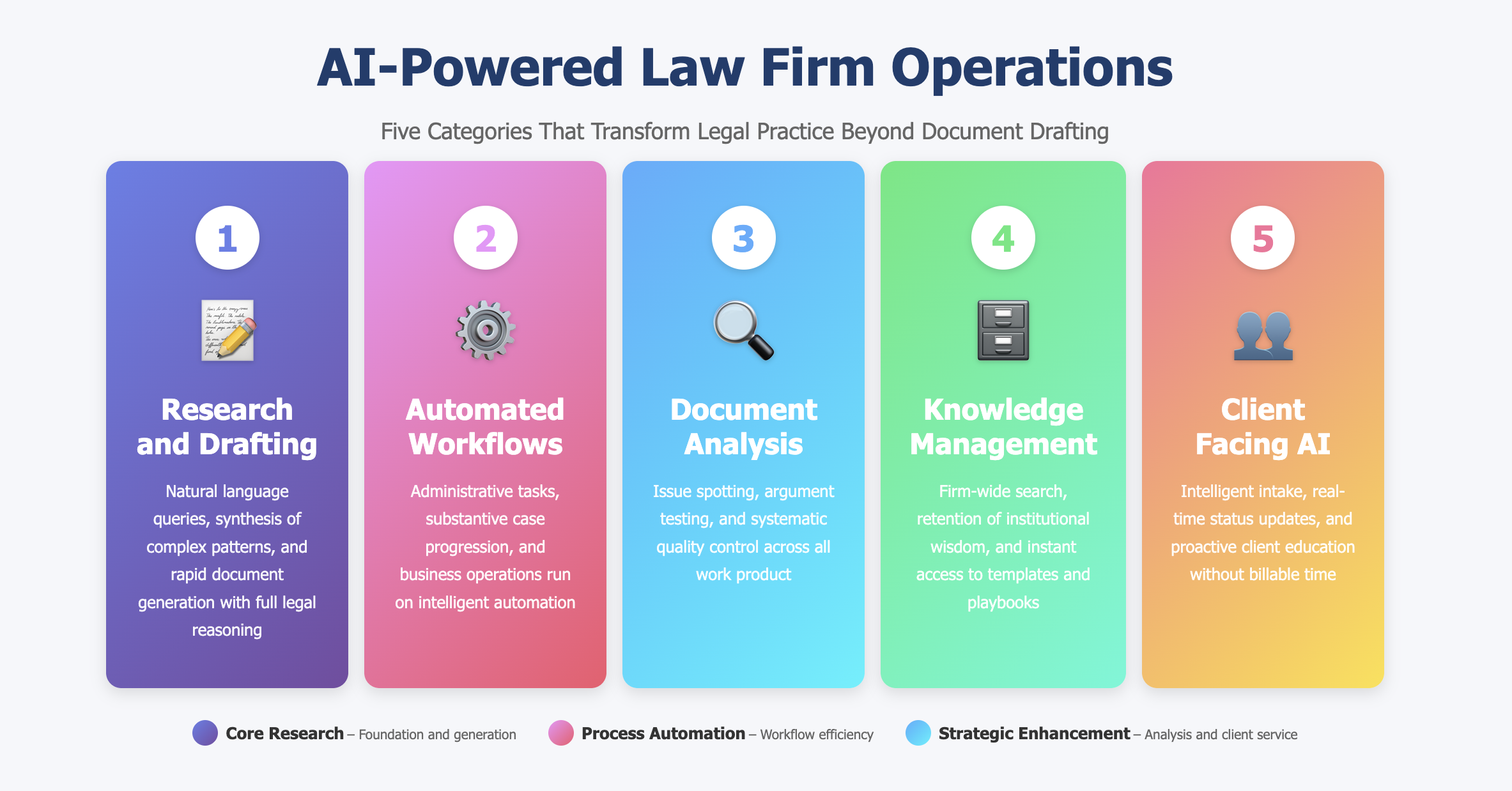
Automated Workflows
This focuses on operational efficiency. Intake processes, follow-ups, file creation, scheduling, document circulation, and internal triggers become structured and self-operating.
The objective is consistency, speed, and reduced manual workload.
This deployment prioritizes workflow mapping, system logic, integrations, and automation sequencing.
Document Intelligence and Analysis
AI is used to evaluate, critique, summarize, stress-test, and extract meaning from legal documents.
This deployment emphasises accuracy, contextual understanding, controlled prompting, and output verification systems.
Knowledge Management Systems
This enables conversational access to your firm’s historical data, case documents, precedent library, and internal knowledge.
The focus here is retrieval architecture, data structuring, and intelligent search design.
Client-Facing AI Systems
This deployment focuses on the client experience. AI supports intake, education, communication updates, and guided interactions.
This prioritizes UX design, messaging control, ethical safeguards, and controlled automation boundaries.
Internal AI Co-Pilots and Decision Support
This deploys AI as a thinking partner for lawyers and staff. It assists with reasoning, evaluation, scenario modelling, and strategic consideration.
This type of deployment requires high trust design, clear guardrails, and operational awareness.
Flexible Implementation Pace
Some firms choose comprehensive deployment across multiple AI categories. Others prefer a phased approach, targeting one functional area at a time.
Both strategies are valid. Both can be structured for success.
A phased approach allows for internal adaptation, training comfort, and cultural integration. A comprehensive approach delivers broader system transformation faster but requires deeper organisational readiness.
Your firm chooses the pace. Jurvantis structures the system accordingly.
The Jurvantis AI Implementation Framework
1. Free AI Strategy Call
Every engagement begins with strategic alignment. We examine your current structure, your ambition for AI, and where meaningful transformation should occur.
What happens here: You describe how your firm operates. We evaluate the real friction points and identify potential AI leverage.
What you receive: High-level clarity on opportunities and deployment scope.
Why it matters: This prevents misalignment and positions the project with precision.
2. Discovery and Systems Audit
We perform a deep analysis of your firm’s operational environment. We assess workflows, data structure, software platforms, document systems, and internal processes.
What happens here: We map reality, not theory.
What you receive: A diagnosis of system readiness and opportunity prioritisation.
Why it matters: AI cannot improve what it does not understand.
3. Deployment Type Selection and Strategy Design
We formally define the AI deployment category or blend being implemented. This becomes the structural backbone of the engagement.
What happens here: We align on deployment type, scope boundaries, and transformation objectives.
What you receive: A defined AI deployment strategy with implementation sequencing.
Why it matters: Clarity prevents scope confusion and uncontrolled expansion.
4. Workflow Architecture and System Design
We translate strategy into structured system design. We define logic, integrations, automation flows, user access levels, and operational touchpoints.
What happens here: We design the system architecture that governs behaviour and output.
What you receive: A documented technical blueprint.
Why it matters: Systems succeed when they are built with structure.
5. Prototype and Controlled Environment Build
We build a sandbox version of your AI system. This allows real interaction before production deployment.
What happens here: You test functionality within a safe, editable environment.
What you receive: A working model of your AI structure.
Why it matters: Iteration occurs before risk enters the main system.
6. Iteration and Alignment Refinement
We refine performance through usage observation and client feedback. We adjust logic, prompts, workflows, and functionality behaviour.
What happens here: The system evolves based on business reality.
What you receive: A calibrated and practical system.
Why it matters: Adoption requires alignment with daily work habits.
7. Platform Integration and Synchronization
We integrate AI systems with your operational software. This includes practice management systems, document platforms, CRM tools, communication systems, and internal databases.
What happens here: We embed AI into your ecosystem.
What you receive: A connected system with unified workflows.
Why it matters: Disconnected tools reduce effectiveness.
8. Deployment into Live Environment
The system transitions from test environment into operational use. We configure it for secure access and live workflows.
What happens here: Your AI system becomes active.
What you receive: A functional, integrated platform.
Why it matters: This stage defines operational reality.
9. Training and Operational Adoption
Your staff learns how to operate the system effectively. We focus on practical usage scenarios and workflow execution.
What happens here: We guide behavioural integration and comfort.
What you receive: Confidence and adoption readiness.
Why it matters: Systems without adoption fail quietly.
10. Optimization and Evolution
AI systems require evolution over time. We monitor performance and adjust workflows as operational needs change.
What happens here: We refine and evolve your AI environment.
What you receive: A system that improves rather than stagnates.
Why it matters: Transformation continues after deployment.
11. Engagement Transition and Ownership
Every engagement results in full system ownership clarity. We ensure your firm controls its data, workflows, and system infrastructure.
What happens here: We formalize transition and long-term continuity.
What you receive: Operational autonomy and stability.
Why it matters: Your system must remain resilient beyond the engagement.
What This Means For Your Firm
You are not purchasing tools. You are entering a guided transformation process.
Your firm gains:
- Structured AI deployment aligned with legal operations
- A clear understanding of which AI types affect which areas of your practice
- Controlled introduction of advanced systems
- Operational efficiency and decision enhancement
- A scalable long-term architecture
Whether you move aggressively or methodically, the process remains the same. Clarity first. Structure second. Execution third.
AI adoption is not a moment. It is an operational evolution.
This is how Jurvantis ensures that evolution is deliberate, controlled, and valuable.