
AI Automated Lead Scoring Workflow for Law Firms
Overview
This workflow uses AI to assign a numerical or categorical value to incoming leads based on predicted quality, urgency, and likelihood of becoming a valuable client. Automated lead scoring helps firms prioritize follow-up, reduce response time for high-value matters, and allocate staff attention where it has the greatest impact.
Lead Scoring Workflow
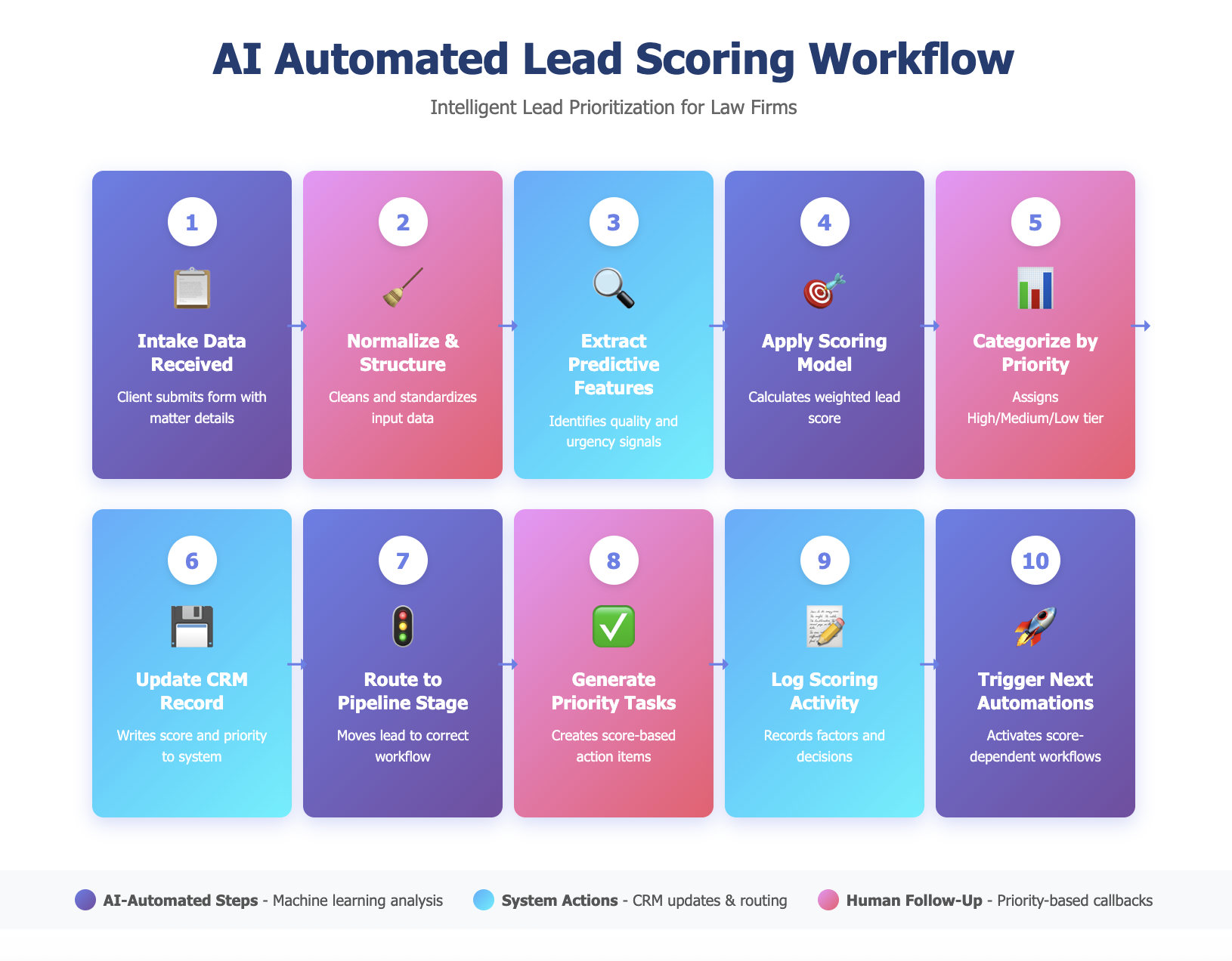
Step 1: Intake Data Received
The workflow begins when a potential client submits an intake form or when staff enter initial information into the system. The lead may include contact details, matter type, narrative facts, urgency indicators, and opposing party names.
Step 2: AI Normalizes and Structures Input Data
AI cleans and standardizes the data. It corrects formatting issues, identifies missing fields, extracts entities from narrative text, and organizes information so that scoring is based on consistent input every time.
Step 3: AI Extracts Predictive Features
AI analyzes the intake information to identify factors that influence lead quality. These can include matter type, keywords that indicate severity or urgency, financial indicators, the timeline of events, the presence of an opposing party, and the clarity of the narrative. AI can extract facts that humans may overlook such as hidden urgency signals or indicators of high complexity.
Step 4: AI Applies the Scoring Model
AI applies the firm’s scoring framework which may include point based scoring, weighted scoring, or a trained predictive model. Points can be assigned for factors such as high value matter type, urgent deadlines, strong documentation, geographic fit, or referral source reliability. Negative points can be applied for non ideal factors such as low budget signals, out of scope matters, or vague descriptions. The AI then calculates a final lead score.
Example: A personal injury lead with keywords like “hospital stay,” “surgery,” and “lost wages” scores +30 points. The referral came from a trusted source (+10). But the incident occurred outside the firm’s geographic area (-15). Final score: 25 (Medium Priority).
Step 5: AI Categorizes the Lead by Priority
AI turns the numerical score into a priority category such as high priority, medium priority, or low priority. This allows staff to quickly understand which leads need immediate attention and which can be handled in routine sequence.
You can get more surgical with scoring if you like such as Platinum (90-100 score), Gold (70-89), Silver (50-69), Bronze (below 50).
Step 6: AI Updates or Creates the CRM Record
AI writes the lead score and priority value into the CRM or practice management system. This score becomes part of the record and determines how the system routes and displays the lead inside the firm’s pipeline.
Step 7: AI Routes the Lead to the Correct Pipeline Stage
Based on the score and matter type, AI moves the lead into the correct workflow stage such as urgent callback, standard follow up, conflict check required, paralegal assignment, or attorney review. High scoring leads can be escalated automatically for immediate human follow up.
Step 8: AI Generates Priority Based Tasks
AI creates tasks that match the priority of the lead. High scoring leads may receive immediate callback tasks while lower scoring leads receive scheduled follow up. This ensures that staff workload aligns with the predicted value of each lead.
Step 9: AI Logs Scoring Activity in the CRM
The system logs the factors used to generate the score, the final score assigned, the category, and the routing decision. This creates transparency and provides data that can be refined over time.
Step 10: AI Triggers Additional Automations Based on Score
AI initiates follow-up workflows that depend on the scoring outcome. For example, high scoring leads may receive a consultation scheduling link or call from an attorney, a personal message from an attorney, or preparation for a conflict check. Lower-scoring leads may receive an automated follow-up email or other low-touch actions.
Why Lead Scoring Matters
Law firms receive leads that vary widely in quality. Some are urgent and high value. Others are low priority or outside the firm’s practice focus. Without automated scoring, staff often treats all leads the same which leads to missed opportunities, delayed follow ups, and inefficient use of resources. Automated scoring allows the firm to respond fastest to the highest value cases, reduce time spent on low value inquiries, and create consistent and objective prioritization. It also improves conversion rates because high scoring leads get immediate attention rather than waiting in an undifferentiated queue.
How Lead Scoring Works
AI evaluates each lead using a combination of structured fields, free text analysis, historical case outcomes, and firm defined criteria. It can score based on matter type, urgency signals, estimated case value, prior interactions, referral source quality, keyword analysis, length and clarity of the intake answers, predicted difficulty of representation, and other factors the firm defines.
Multiple scoring methods exist including simple point based systems, weighted models, and machine learning models that study past successful cases and learn which characteristics predict positive outcomes. The exact method varies but the goal is the same which is to produce a priority value that tells the firm which leads deserve immediate action and which can be scheduled for routine follow up.