

The 5 Main Ways AI Can Transform Your Law Practice
There Is More to AI in Law Than Drafting Documents
This is an important article because many don’t fully appreciate all what AI can do for a law firm. It’s so much more than drafting.
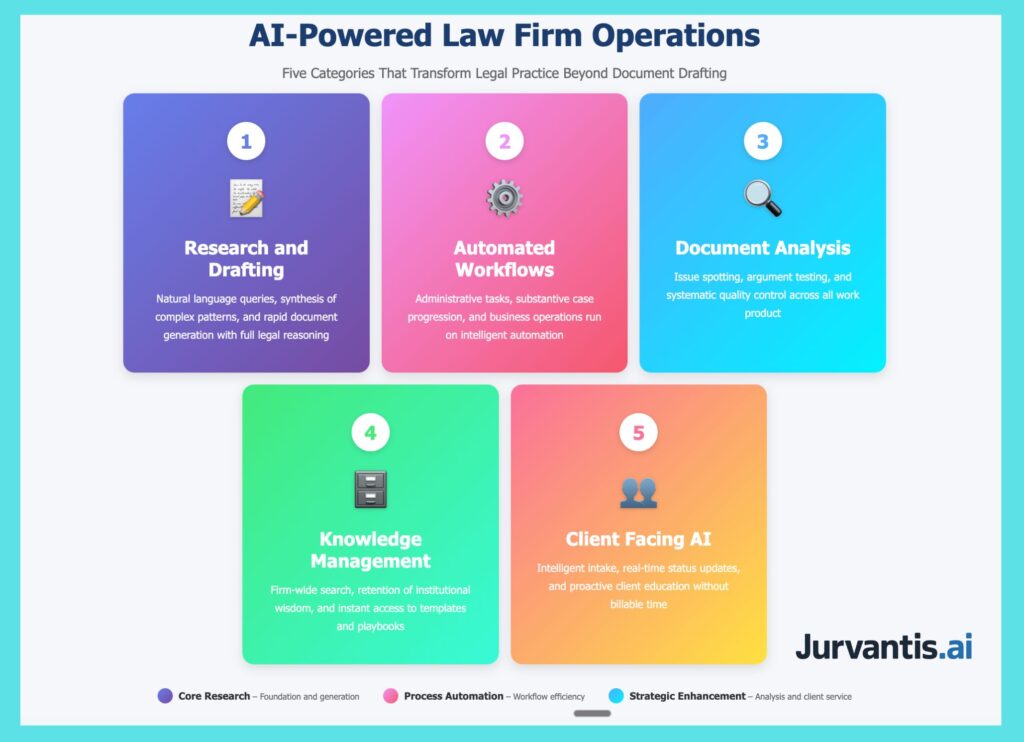
If you spend any time around legal tech conversations, you hear one claim on repeat. AI helps you draft things. It writes briefs, letters, motions, memos and research notes. That part is true, and it is important. But you only see a fraction of the real picture if you stop there. AI already supports the legal profession in five major categories, and document drafting is only one of them. When you understand the full landscape, you start to see how AI reshapes the entire operating system of a modern law firm.
1. Research and Drafting
Most lawyers think of AI as a drafting machine. You type in a prompt and you receive a memo or an argument back. That workflow now feels familiar, but the category runs deeper than simple text generation.
Information Retrieval
You can query your entire legal database with natural language. Ask about venue requirements in a specific jurisdiction and receive synthesized answers that pull from case law, statutes and secondary sources. Tools like CoCounsel and Harvey have made this standard practice in many firms. You skip the Boolean search gymnastics and get straight to the relevant authority.
Synthesis and Reasoning
The models also reason through complex fact patterns. You present a set of circumstances and ask whether they support a particular claim. The system analyzes the elements, identifies gaps and points you toward supporting or contradicting precedent. This goes beyond keyword matching. The AI interprets your specific situation against established legal principles.
Document Generation
Then comes generation. You request a demand letter and receive a structured draft in seconds. You still edit for tone, strategy and judgment, but you start from something coherent instead of a blank page. This piece of the puzzle gets all the attention, but it works best when combined with the research and reasoning that precedes it.
The combination of retrieval, synthesis and generation makes AI a complete research partner, not just a typing service.
2. Automated Workflows
Law firms run on repeatable processes. Intake follows a pattern. Discovery has predictable stages. Settlements require standard documentation. AI now handles these sequences with less manual intervention.
Administrative Automation
Start with administrative work. Your intake process captures client information, checks for conflicts, creates matter files and schedules initial consultations. AI can manage this entire chain. The system asks the right questions, routes information to the proper people and triggers the next steps without anyone touching it. This eliminates the data entry backlog that bogs down small and mid size firms.
Substantive Automation
Substantive automation goes further. Personal injury cases follow a clear progression from signed retainer through medical record collection, demand preparation, negotiation and settlement. You can build workflows that monitor deadlines, prompt team members when tasks come due and flag issues when something sits too long. The AI watches your pipeline and keeps everything moving forward.
Business Operations Automation
Business operations get the same treatment. Lead scoring systems identify which inquiries deserve immediate attention. Follow up sequences nurture prospects who are not ready to hire. Billing triggers fire when certain milestones hit. You create the rules once and the system executes them consistently.
The firms making the biggest efficiency gains are not the ones writing better briefs. They are the ones automating the hundred small tasks that used to require constant attention.
3. Document and Reasoning Analysis
This is where AI shifts from assistant to sparring partner. You stop asking it to produce and start asking it to critique.
Document Review and Issue Spotting
Upload a contract and request issue spotting. The model identifies ambiguous terms, missing provisions, inconsistent definitions and potential enforcement problems. You catch risks before they become disputes. Firms doing high volume transactional work now run every agreement through this kind of review as standard quality control.
Argument Testing
You can also stress test your arguments. Present your motion for summary judgment and ask the AI to argue the opposing side. It generates counterarguments, identifies weaknesses in your reasoning and points out case law you might have missed. This costs nothing and takes minutes. A junior associate doing the same analysis would bill hours and still might not match the breadth of research the model provides.
Quality Control
Quality control becomes systematic instead of sporadic. Compare your brief against court rules and prior successful filings. The AI highlights formatting errors, missing sections and stylistic inconsistencies. You maintain a higher baseline across your entire team without micromanaging every document.
The weakness here is that AI cannot replace legal judgment. It spots issues but does not prioritize them. It generates counterarguments but does not tell you which ones a judge will find persuasive. You still need to think. The difference is you think faster and with more information at your disposal.
4. Knowledge Management and Internal Search
Every firm accumulates institutional knowledge. It sits in closed files, old emails, partner work product and templates that live on random hard drives. The challenge has always been retrieval. AI changes that equation.
Firm Wide Search
You can now search your firm’s entire history with natural language queries. Ask for motions to compel in employment cases where the opposing party refused to produce text messages. The system surfaces relevant examples in seconds. You are not guessing at folder names or bothering colleagues who might remember something similar from three years ago.
Knowledge Retention
This matters most when experienced lawyers leave. Firms lose decades of practical wisdom every time a senior partner retires. AI lets you capture that knowledge while it still exists. You can interview departing attorneys, record their insights and make the information searchable for future team members. The institutional memory persists instead of walking out the door.
Template and Playbook Access
Template access becomes frictionless. You need a specific contract clause or a standard discovery objection. Instead of hunting through shared drives or asking around, you query your knowledge base and receive the approved language instantly. This reduces errors and speeds up routine work.
The firms investing in knowledge management now are building a permanent advantage. They convert experience into a searchable asset that compounds over time.
5. Client Facing AI
AI does not just change how you work. It changes how clients experience your firm. You can provide faster response times, clearer communication and more consistent service without adding staff.
Intake and Onboarding
Intake becomes smoother. Prospective clients answer preliminary questions through an AI guided form that adapts based on their responses. The system gathers facts, documents and contact information before a lawyer reviews anything. This creates a better first impression and ensures you collect complete information from the start.
Status Updates and Communication
Status updates no longer require billable time. Clients can ask about case progress and receive accurate summaries of recent activity, upcoming deadlines and next steps. The AI pulls from your case management system and delivers information in plain language that clients actually understand.
Client Education
You can also provide proactive education. Clients want to know what happens next in their case, how long things typically take and what they should expect at each stage. AI can deliver this information consistently without requiring a paralegal or attorney to explain the same process for the hundredth time.
The risk here is depersonalization. Clients hire lawyers for expertise and judgment, not chatbots. The firms that succeed with client facing AI use it to handle routine information requests while preserving human interaction for strategic decisions and relationship building.
The Complete Picture
You improve your practice when you see AI as more than a drafting assistant. These five categories represent different ways AI integrates into firm operations. Research and drafting get the headlines. Workflow automation delivers immediate efficiency gains. Document analysis sharpens your work product. Knowledge management protects institutional wisdom. Client facing tools improve service delivery.
The firms pulling ahead are not the ones using AI in one category. They are the ones building systems across all five. They automate intake, research faster, test arguments harder, surface past work instantly and keep clients informed without burning billable hours. This is not about replacing lawyers. It is about building a practice that operates at a fundamentally different level of speed and consistency.
The technology already exists. The question is whether you will deploy it strategically or watch competitors do it first.

Jon Dykstra, LL.B., MBA, is a legal AI strategist and founder of Jurvantis.ai. He is a former practicing attorney who specializes in researching and writing about AI in law and its implementation for law firms. He helps lawyers navigate the rapid evolution of artificial intelligence in legal practice through essays, tool evaluation, strategic consulting, and full-scale A-to-Z custom implementation.